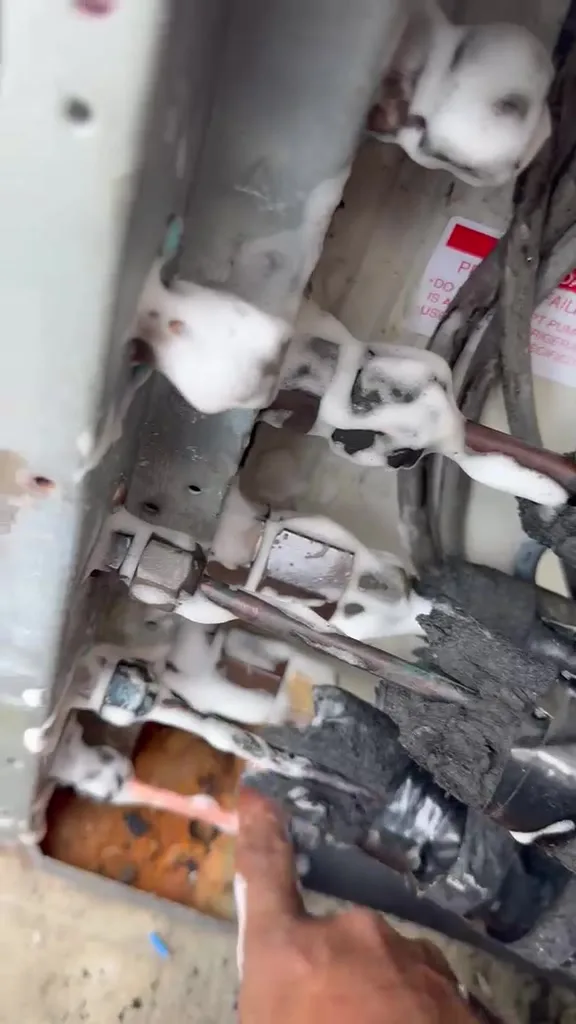
Pictured above: a soap-bubble leak check at the outdoor unit of a Bukit Panjang condo on 18 November 2026. The owner had gone ahead with a repair on one indoor unit after earlier checks. Our team fitted a new wall blower, replaced and concealed the pipes, topped up R32 and then checked the joints for leaks. The white foam on the pipe connections is the check. The photos are on the live job page.
If you have been told your aircon is low on gas, you will probably hear two different ways of looking for the leak. One is quick and costs nothing extra to watch: the technician brushes or sprays soapy water on the pipe joints and looks for bubbles. The other is the nitrogen pressure test, which is $180 per indoor unit on our pressure test price list and leaves the aircon unusable for 2 to 3 days.
So the fair question from a homeowner is: why pay for the nitrogen test if soapy water can find a leak? Here is what each check can see, and when each one is the right call.
Why anyone is looking for a leak at all
Refrigerant is not used up like petrol. It goes round a sealed loop between the indoor and outdoor units. Our gas leak repair page puts it plainly: low gas almost always means a leak, not gas that was "used up". If the gas went somewhere, topping it up without finding where it went means the new gas can leave the same way.
That is why the search for the leak matters more than the top-up. A top-up on its own is a flat price per outdoor circuit on our price list: R22 $115, R410A $130, R32 $170. Paying that every few months for a leak nobody has found is the expensive route.
The first check comes with every visit
Before anyone reaches for soap or nitrogen, every service visit starts with our 9-point pre-check, included in the $55 visit for 1 unit. Three of the nine points are about gas and pipework:
- Compressor pressure reading: professional gauges check the refrigerant pressure. This is the gas pressure check that comes with the $55 visit.
- Outdoor condenser inspection: a visual check of the fan, the condenser coil and the external pipework.
- Damage and corrosion check: a physical look for rust, refrigerant oil stains, cracked piping and other visible damage.
The gauge reading tells the technician whether the system is short of gas. It does not tell anyone where the gas is escaping. That is the job of the next two checks.
What a soap-bubble check is
It is the simplest leak check there is. Soapy water is put on a joint that is holding gas under pressure. If gas is escaping there, it blows bubbles through the film, and the bubbles show the spot. If the film just sits there, nothing is escaping fast enough to show at that joint, at that moment.
It suits the places where pipes are joined and can be reached: the connections and service valves at the outdoor unit, and the connections at the indoor unit once the cover is off. Those joints are among the usual places a leak starts. Our gas leak page lists the typical culprits as a loosened flare joint, a corroded coil and a pinhole in the piping.
It is also the natural last step after a repair. On the Bukit Panjang job above, the joints at the outdoor unit were covered in foam after the work and the top-up. The point of that check is to confirm the connections that were just made, before the technician leaves.
What the soap check cannot see
This is the part a homeowner rarely gets told. Soapy water only works where it can be put, and where gas is pushing hard enough to bubble. That leaves real gaps:
- Pipes you cannot reach. Piping run inside trunking, above a false ceiling or behind a wall cannot be painted with soap without opening it up. Many Singapore flats and condos have exactly this, especially where the pipes were concealed for a clean finish. Our post on concealed aircon pipes in a condo ceiling shows what that work looks like.
- The coil itself. A pinhole in the coil inside the indoor unit, or in the condenser coil outside, is not a joint you can wipe and watch.
- Slow leaks. A leak that loses gas over months may not throw a clear bubble during a short look. A clean result at the joints you checked is not the same as "no leak".
- A system that is almost empty. With very little gas left in the pipes, there may not be enough pressure to make bubbles at all.
What the nitrogen pressure test adds
The nitrogen test looks at the whole piping set at once, including the parts nobody can see. As our pressure test page describes it, the refrigerant piping set is isolated and pressurised, then the gauges are watched. A steady reading means the piping set is sealed. A dropping reading confirms a leak. The leak is then traced to its source: a flare joint, a valve connection, the piping run or the coil itself.
The difference is the gauge. A soap check only sees bubbles where soap was put. A pressure test can show that a piping set is leaking even when the leak is hidden, and then the search narrows down from there.
From the published prices, the nitrogen test is:
- 1 indoor unit: $180, only if you know which unit leaks
- System 2 (2 units): $360
- System 3 (3 units): $540
- System 4 (4 units): $720
The aircon cannot be used for 2 to 3 days. Our post on planning for 2 to 3 days without the unit covers how to work around that, and our post on testing one unit or every unit covers when $180 is enough.
When the soap check is enough, and when it is not
This is our reading of the two checks, not a rule printed on a price list. Put simply:
The soap check can be enough when the pre-check points to one reachable joint. For example, oil staining at a connection on the outdoor unit, a joint that was disturbed recently, or a unit that was moved or re-installed and lost gas soon after. If soapy water then shows bubbles at that joint, the leak has been found without opening anything.
It is not enough when the joints you can reach show nothing but the gauge still says the gas is low. That points to somewhere the soap cannot reach. It is also not enough when the pipes are concealed, when a top-up has already been done more than once, or when cooling has faded slowly over weeks. In those cases the nitrogen test is the way to stop guessing.
A "no bubbles" answer on a system that has already had two top-ups is not good news. It usually means the leak is somewhere nobody looked yet. Our post on where refrigerant leaks actually happen goes through the common spots.
What happens once a leak is found
You get the finding and the price before any work starts. From our published prices:
- Leaking pipe change: $520 per fan coil unit in an HDB flat, $700 per fan coil unit in a condo.
- Concealed pipe work or coil repair: quoted after the pressure test, before any work.
- Compressor replacement: quoted on site, and the price varies by site.
- The gas afterwards: the top-up is the flat price per outdoor circuit above.
If you decide not to go ahead with a repair, our pressure test page says you pay only for the visit and any pressure test already carried out, nothing towards the repair. Repair work carries a 90-day workmanship warranty. Our post on how to tell a gas leak repair held explains what to watch in those 90 days.
Six questions to ask before you approve either check
- "What did the gauge reading show, and what pressure should this system be at?"
- "Which joints did you check with soap, and did any of them bubble?"
- "Are any of my pipes concealed, in trunking or above the ceiling, where soap cannot reach?"
- "If the soap check shows nothing, what is the next step and what does it cost?"
- "If you recommend the nitrogen test, is it for one unit or the whole system, and why?"
- "After the repair, will you check the joints you worked on before you leave?"
Clear answers to these tell you whether the leak has really been found or only guessed at. Ask for a photo of any joint that bubbled. It is your record if the cooling fades again.
What you can check yourself first
Do not open the unit or touch the valves. You can still collect useful facts:
- Look at the copper pipes under the indoor unit and at the outdoor unit, if it is safe to see from the window. Note any ice or frost, and any dark oily staining at the connections.
- Read the sticker on the outdoor unit or the side of the indoor unit for the refrigerant type: R22, R410A or R32.
- Write down the history: when the last top-up was, and how many there have been.
- Note how the pipes run: visible on the wall, in trunking, or hidden in the ceiling.
Our post on frost on the outdoor valve explains what frost there usually means.
The short version
- The gauge reading in the $55 pre-check tells you whether the gas is low. It does not say where it went.
- A soap-bubble check finds leaks at joints that can be reached. It is quick, and it is the right last step after a repair.
- It cannot see inside trunking, ceilings or coils, and it can miss slow leaks.
- The nitrogen test, $180 per indoor unit, checks the whole piping set by watching the gauge, and the leak is traced from there.
- No bubbles plus low gas means keep looking, not top up again.
Tell us what you have been told
Send us the property type, how many indoor units share the outdoor unit, the refrigerant type if you can read it, when the last top-up was, and whether your pipes are visible or concealed. A photo of the sticker and of the pipe connections helps. That is enough for us to tell you whether a check of the reachable joints is a sensible first step, or whether the nitrogen test is the honest answer, with the price confirmed before anyone comes.