Almost every piece of aircon advice online quietly assumes a flat that is about five years old. If you live in Bukit Batok, Ang Mo Kio, Clementi, Toa Payoh, Marine Parade, Bedok or any of the blocks that went up before the 1990s, a fair amount of it does not apply to you.
The unit on your wall may be twenty years younger than the flat, but it was fitted into a building that was never designed around it. That is what changes. Not the service itself — a coil is a coil — but everything around it: where the pipes run, where the water is supposed to go, what the electrical supply can carry, and how much of the previous owner's work you have quietly inherited.
This is what we actually find in older flats, and what it means for what you should book.
The aircon was added later, and the drain line is where you notice
In a newer flat the condensate drain is planned in. There is a proper fall from the fan coil to a discharge point, the pipe is short, and it sits inside the false ceiling or trunking from day one.
In an older flat the aircon was retrofitted, often twice. The drain has to get from wherever the unit was mounted to whatever outlet the installer could reach — usually the service yard floor trap or a hole cored through the wall. That makes the run longer, flatter, and full of joints. A long shallow drain works fine when it is clean and stops working the moment biofilm narrows it.
This is why water dripping from the front of the unit is so much more common in older blocks, and why it comes back a month after someone "cleared" it. Blowing the line through clears the symptom. On a long flat run, the pan and the first metre of pipe are where the slime actually lives, and getting to those properly is a strip-down, not a flush.
If your unit has leaked more than once in a year, the honest answer is usually not another general service. It is a deep clean that includes the drain pan, and sometimes it is re-routing the drain so it has somewhere to fall to.
Long-running units fail from the blower wheel inwards
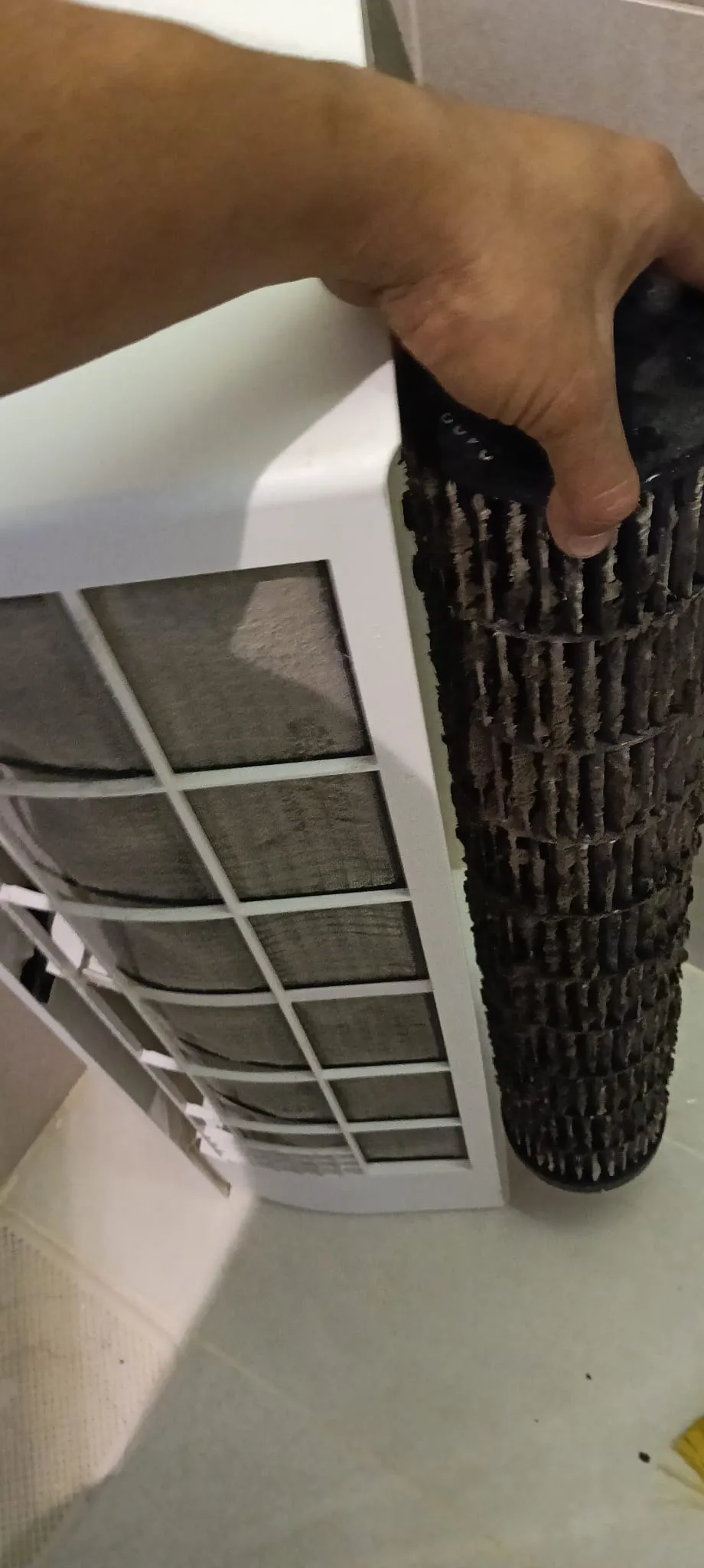
The part that surprises people is not the coil. It is the blower wheel — the long black barrel behind the coil that actually moves the air.
Dust does not sit on it evenly. It builds into a furred crust in the gaps between the blades, and because it builds slowly, nobody notices the airflow dropping. The flat just becomes a bit less cold each year, and the natural reaction is to set the thermostat lower, which raises the bill without fixing anything.
A unit that has run for a decade in a flat with the windows open on a main road, or near a kitchen where the door is usually open, gets there faster. When we take the blower wheel out of a unit like that, the fouling is thick enough to hold its shape.
The practical point: a general service at $45 for one unit is filter clean, coil wipe, drainage flush and gas check. It is the right routine job every three months and it is not the job that fixes a fouled blower wheel. That needs a chemical wash, at $135 for one unit, or a full overhaul at $200 for one unit if the wheel and drain pan need to come out. We have written separately about what a chemical wash cannot fix, because the distinction matters more in old units than new ones.
You are probably maintaining somebody else's installation
A flat from the 1980s has usually changed hands at least once, and the aircon has been replaced at least once. What you own is the last installer's decisions, and you generally did not get to see them.
Things worth knowing about your own flat, all of which you can check without a technician:
- Where the pipes run. Surface trunking along the ceiling line is normal in older flats. What matters is whether it is continuous, or whether it disappears into a false ceiling section that has no access panel. If there is no panel, the next person to work on that pipe has to cut.
- Whether the outdoor units are on a proper ledge or on brackets. Some older blocks have no dedicated condenser ledge, so the condenser sits on a bracket outside a window or in the service yard. Bracket-mounted units are serviceable, but the condition of the bracket becomes your problem over time.
- How many indoor units share one condenser. If a previous owner added a room, they may have added an indoor unit to a system that was not sized for it.
- Whether the drain discharges to the floor trap or through a wall. A through-wall discharge that drips onto the unit below is not a maintenance problem, it is a neighbour problem, and we have written about how those get resolved.
None of this is a reason to panic. It is a reason to have the technician tell you what is there, once, so you stop paying to rediscover it.
Older refrigerant is the one genuinely awkward part
If a system was installed a long time ago, it may run on an older-generation refrigerant rather than the R32 used in current units. That matters for one practical reason: the older the gas, the less routine it is to source, and the less sense it makes to keep topping up a system that is losing it.
Topping up a system with a leak is money into a hole. We have set out how to tell a top-up from a leak repair — the short version is that a system which needed gas last year and needs it again this year does not need gas, it needs the leak found. On an old system, that is also the moment to have an honest conversation about whether repair or replacement is the better spend, which depends mostly on how long the unit has already run.
If you are heading towards replacement rather than repair, the pipework question comes with it: reusing existing copper in an older flat is sometimes fine and sometimes not, and we have covered what changes when you replace an aircon in an older HDB flat in detail.
Access costs are real, and they are not a surcharge on you
Two access situations genuinely change the work. High floors where the condenser can only be reached from a narrow ledge take longer and need more care — we explain why ledge access affects servicing separately. And in a few older estates the only parking near the block is commercial, in which case a parking charge of $10 to $20 applies. That is the only add-on on our list; the displayed service price is the final price.
What to do if your flat is one of these
A sensible order, in plain terms:
- Find out when the units were last opened up — not last serviced, last actually opened. If nobody knows, assume it has never happened.
- Book one deep clean rather than three general services. On a long-neglected unit, a general service every three months does not catch up. Get it back to a clean baseline once, then keep it there with the routine job.
- Ask for the drain pan to be shown to you. A technician who has taken the pan out can show you what came off it. If your unit has a leak history, this is the part that matters.
- Do the units together, not one at a time. Our prices fall per unit as you add units — general servicing is $45, $70, $95 and $115 for one to four units, and $25 per unit from five. A chemical wash is $135, $245, $345 and $425, and $100 per unit from five. Two units due in the same quarter are materially cheaper done in one visit.
- Get the layout written down. Where the pipes run, where the drain goes, which breaker isolates the aircon. It takes five minutes on the day and saves an hour every time after.
The short version
Old flats do not need special aircon servicing. They need servicing that accounts for a system that was retrofitted into a building that never expected it — longer drain runs, inherited pipework, and units that have been quietly losing airflow for years. The routine job is the same. The starting point is not.
If your block is one of the older ones and you are not sure whether you need a general service, a wash or a full overhaul, tell us the age of the flat, the age of the units and what the aircon is actually doing. We would rather put you on the cheaper job and be right than sell you the bigger one. WhatsApp us on 9107 2601 — usually a reply within five minutes.